
Iron and Steel
Steel is one of the most important materials for modern infrastructure, transport, machinery and industrial development. Its production is also highly energy- and carbon-intensive, particularly in primary ironmaking routes that rely on coal and coke as both fuels and reducing agents.
Decarbonizing iron and steel production requires a combination of energy efficiency, increased scrap use, electrification, low-emissions electricity, hydrogen-based direct reduction, material efficiency, and carbon capture solutions depending on the production route, available infrastructure and regional conditions.
Current Production Routes
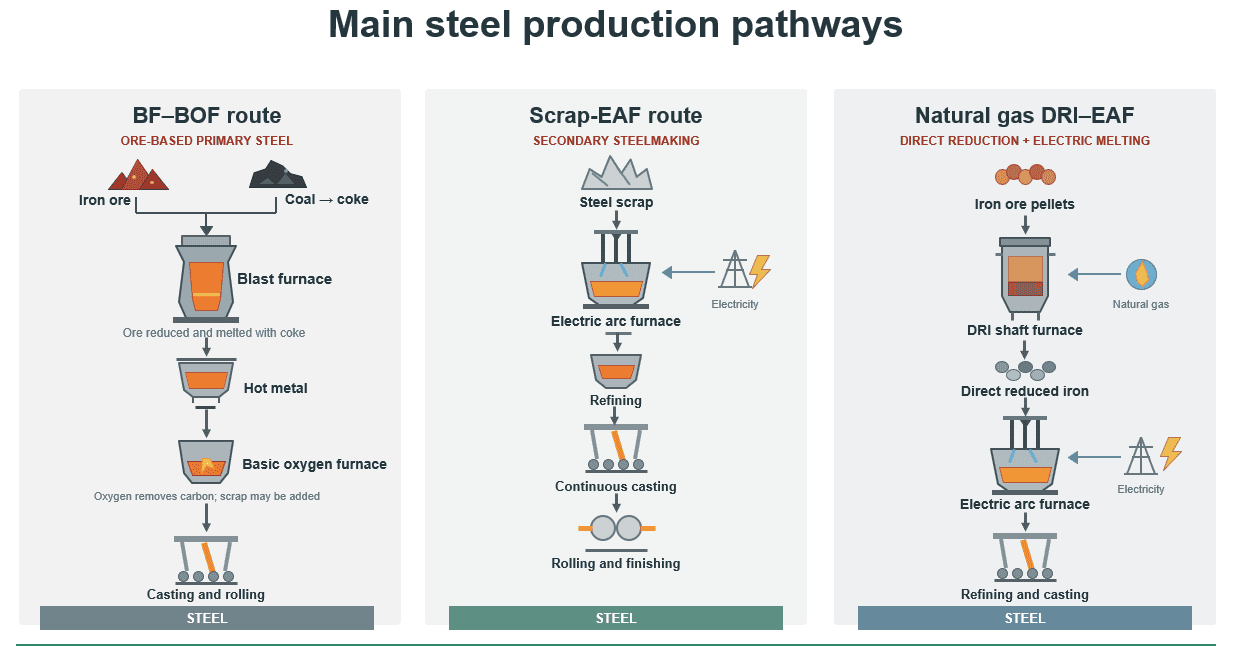
Steel is produced mainly through the integrated blast furnace–basic oxygen furnace (BF–BOF) route and electric arc furnace (EAF)-based routes. Their energy use and emissions depend on the iron-bearing inputs, fuels and reducing agents, electricity supply, and the processes included in the system boundary.
Blast furnace–basic oxygen furnace (BF–BOF): Iron ore is prepared as sinter or pellets, while coal is converted into coke. In the blast furnace, coke supplies heat and acts as a reducing agent, producing molten hot metal from the ore. The hot metal is transferred to a basic oxygen furnace, where oxygen removes excess carbon and other impurities; scrap may also be added. The crude steel is then cast, rolled, and finished. BF–BOF is a major route for primary steel production and relies heavily on coal and coke.
Scrap-based electric arc furnace (EAF): An EAF uses electricity to melt metallic inputs, typically steel scrap. It can also use direct reduced iron (DRI), hot metal, or a mixture of these materials. The molten steel is refined to the required composition, then cast, rolled, and finished. Emissions depend on the metallic charge and the electricity mix. A scrap-based EAF supplied with low-emission electricity can have substantially lower emissions than BF–BOF production, although scrap availability and quality affect how widely this route can expand.
Natural gas-based direct reduced iron–electric arc furnace (NG-DRI–EAF): In this route, iron ore is reduced in solid form in a direct reduction furnace using a reducing gas produced from natural gas. The resulting DRI is then melted in an EAF, often together with scrap, and refined into steel before casting, rolling, and finishing. The route avoids coke-based blast furnace ironmaking, but it still uses natural gas and electricity; its emissions depend on the amount and source of the gas, upstream methane emissions, and the electricity mix.
Emissions Reduction Options
- Improve energy efficiency: Improve plant performance through stronger process control, regular maintenance, waste-heat recovery, and the adoption of best available technologies. These measures can reduce energy use and emissions in the near term, but cannot achieve the full long-term transition on their own.
- Shift primary ironmaking towards hydrogen-based DRI–EAF: Use electrolytic hydrogen to produce direct reduced iron (DRI), followed by steelmaking in an electric arc furnace (EAF). This is an emerging low-emissions option, particularly where low-emissions hydrogen and electricity are available at suitable cost and scale.
- Apply carbon capture, utilisation and storage (CCUS) to suitable production routes: Assess the potential for CO₂ capture in BF–BOF, natural gas-based DRI, and innovative smelting routes. Deployment depends on suitable capture conditions and access to CO₂ transport and storage infrastructure.
- Electrify suitable process equipment: Replace fossil-fuel-based equipment with electric alternatives where technically feasible, alongside a progressively lower-emissions electricity supply.
- Use steel and materials more efficiently: Improve manufacturing yields, reduce avoidable demand for materials, reuse steel products, and extend product lifetimes. Reducing demand for primary steel can also lower emissions across the sector.
- Increase scrap-based production where feasible: Improve scrap collection, sorting, and preparation, and use suitable scrap in EAFs. Scrap-based production can reduce reliance on primary ironmaking, although the available quantity and quality of scrap limit how much it can contribute.
- Plan asset transitions and enabling infrastructure: Coordinate investment in production assets with the development of electricity grids, hydrogen supply, CO₂ transport and storage, and markets for low-emissions steel.
Explore a pathway for your steel production route
We can help assess current energy and emissions performance, compare technology pathways, and evaluate the implications of electrification, hydrogen, scrap use, efficiency measures and CCUS for your production system.